
Why Manual Scheduling Is the Hidden Bottleneck Killing HVAC and Plumbing Dispatchers
Manual scheduling delays cost HVAC and plumbing businesses booked jobs every day. See the data and learn how automation closes the gap.
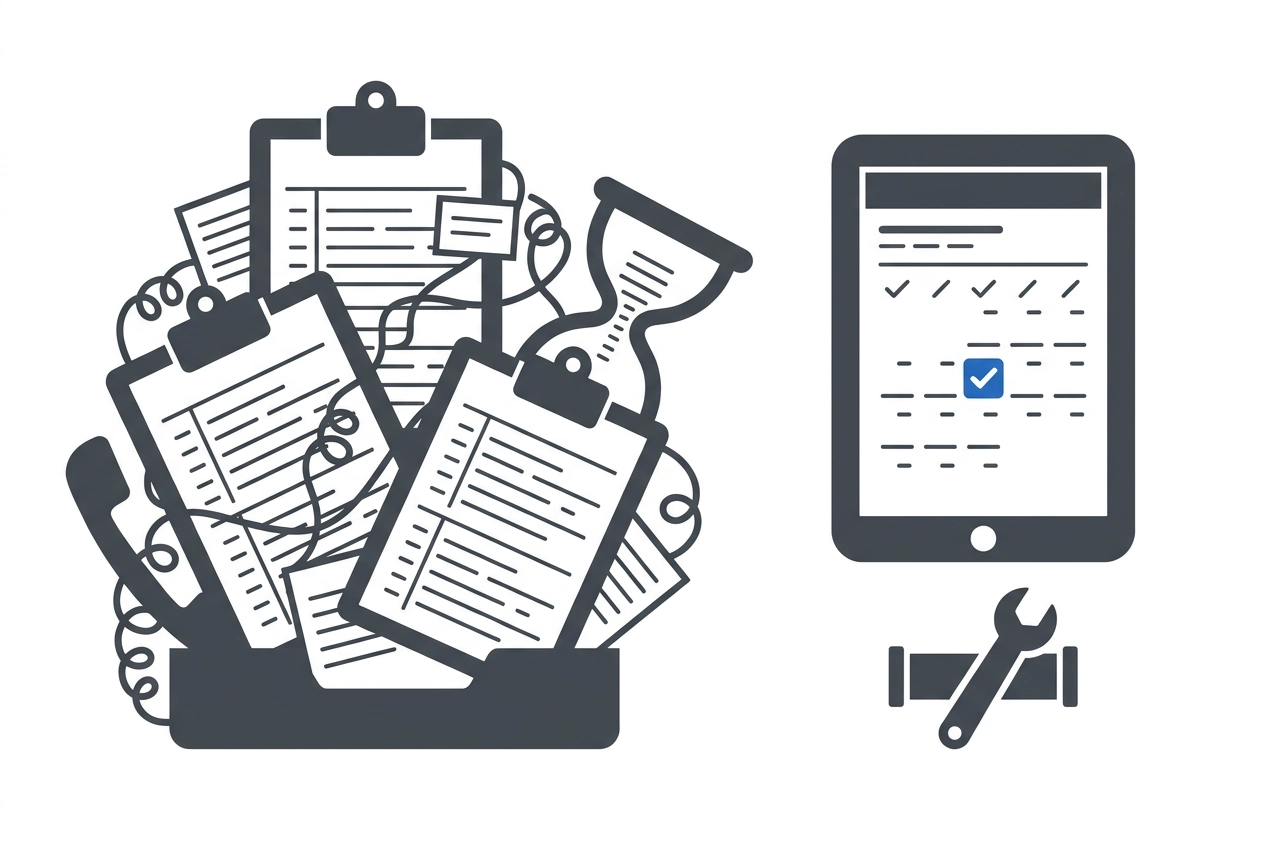
Every booked job in your pipeline started as a phone call or a form submission. What happened in the minutes after that inquiry is where most HVAC and plumbing businesses quietly bleed revenue. Not because their technicians are unavailable, and not because their pricing is off. Because the gap between "I need service" and "appointment confirmed" is simply too long when every step is handled manually.
That gap is the real bottleneck, and scheduling automation is how you close it.
This post breaks down exactly where manual dispatching loses jobs that should have been won. You will see how individual touchpoints compound into costly delays, what the conversion data says about response time, and why plumbing and HVAC businesses face a uniquely urgent version of this problem. You will also learn what automation actually changes in the workflow, how the after-hours booking window is draining revenue most operators are not even tracking, and what the dispatcher's role looks like once the manual friction is removed. By the end, the case for acting on this will be a revenue argument, not a technology argument.
The Real Reason Bookings Fall Through
Most HVAC and plumbing businesses that struggle to fill their schedules aren't short on technicians. They're losing jobs before a tech is ever dispatched. The real bottleneck sits between the moment a customer picks up the phone and the moment they hear "you're confirmed for Thursday."
The numbers make this hard to ignore. Home services convert only 7.8% of leads into paying customers in 2026, a figure that reflects everything falling through the cracks before a single wrench is turned. That's not a field performance problem. It's a front-end problem.

Phone leads can convert at 46% when handled correctly, but that rate is conditional. It depends entirely on how fast and smoothly the scheduling process runs from first ring to confirmed appointment. Slow the process down with manual steps, and that ceiling drops fast.
Here's the part worth sitting with: 37% of phone leads convert on the very first call. That means any process requiring a callback is already operating at a disadvantage before it starts. The customer called ready to book. A callback asks them to wait, stay available, and hope the timing works out.
It rarely does. 79% of leads fail to convert without proper nurturing, and the manual scheduling process is one of the most consistent places that nurturing breaks down. Leads enter the system, hit a delay, and exit quietly before anyone notices.
Scheduling isn't hard. The problem is that every manual touchpoint, the call log, the calendar check, the callback attempt, compounds the delay. Compounding delays cost booked jobs. If you want to see how much your current process may be costing you, a revenue leak audit is a practical place to start.
Mapping the Manual Touchpoints That Add Up Fast
So what does that delay actually look like in practice? It is not one big failure. It is six small ones, stacked in sequence.
A typical service call moves through this chain: answer the call, log the request, check technician availability, navigate the calendar, quote a time window, and confirm back with the customer. Each step hands off to the next, and each one is a place where time is lost or the customer quietly disengages.
The chain only holds when a dispatcher is available for the entire sequence. When they are already on a call, the process does not slow down; it stops completely. The new caller goes to voicemail, and most of them do not wait.
Callback scheduling compounds this. Even when a dispatcher calls back promptly, the customer has to be reachable, free to talk, and still motivated to book. That alignment fails more often than dispatchers realize, and every failed callback is a lead that entered the pipeline and quietly exited before a job was ever logged.
This is the structural problem with manual field service scheduling: the dispatcher is the single point of failure for every booking. One unusually busy morning does not just slow the schedule; it backs up the entire day's pipeline. Requests pile up, callbacks stack, and by the time a dispatcher surfaces, several of those leads have already booked with someone else.
The issue is not dispatcher speed or effort. It is that a six-step manual process running through one person cannot scale when call volume spikes. Cognitive load rises, small errors creep in, and the one metric that determines whether a lead converts, time to confirmation, stretches exactly when it needs to shrink.
The Numbers That Make This Undeniable
Those structural inefficiencies are not just inconvenient. The data shows exactly what they cost.
Responding to an inbound call within 60 seconds improves conversion rates by up to 391%. That is not a modest improvement; it is the difference between a business that wins the job and one that wonders where its leads went. Speed is the competitive advantage, and it belongs entirely to whoever picks up first.
The five-minute window is equally unforgiving. Research from MIT and Harvard Business Review found that businesses responding within five minutes are 100 times more likely to reach a lead than those who wait 30 minutes. Most manual callback sequences do not come close to five minutes.
Lead quality does not hold while a customer waits. It drops 80% after that first five-minute window closes. By the time a dispatcher returns a call between other tasks, the lead is already cooling. And 78% of customers book with the first business to respond, meaning a slow manual process does not just delay the booking, it actively transfers the job to a competitor.
The baseline problem compounds it further. Only 61% of home service callers actually reach a person on the first call. Nearly four in ten callers are already being pushed into a waiting pattern before a single scheduling step has even begun.
These are not edge-case scenarios. They describe what happens to ordinary inbound volume every day when field service automation is absent from the front end of the booking process. If you want to understand where revenue disappears before a technician ever gets involved, ready to stop losing calls? The answer is in these numbers.
Why Urgency Makes This Worse for Plumbing and HVAC Specifically
Those response-time statistics hit differently when you apply them to a customer standing in two inches of water.
Plumbing leads convert at 12 to 16%, among the highest rates in all of home services. That number exists precisely because urgency removes comparison shopping. A homeowner with a burst pipe is not opening three browser tabs and reading reviews. They are calling the first number they find and expecting someone to answer. The moment they hit voicemail or hear "we'll call you back," that urgency transfers directly to your competitor.
HVAC follows identical logic at scale. A household without heat in January or air conditioning in July is not a patient customer willing to wait for a callback window. They are a motivated buyer with a short tolerance for friction, and peak season is exactly when manual dispatchers are most likely to be overwhelmed, on hold with another customer, or simply unavailable.
That is the cruel irony baked into manual scheduling for these trades. The call volume spikes that represent the highest revenue opportunity are the same conditions that cause the manual process to break down most often. Busy periods do not reveal the system's strength; they expose its ceiling.
Then there is the after-hours problem. Roughly 40% of all service appointments are booked outside standard business hours, with Sunday evenings between 4 and 8 PM consistently representing peak booking activity. A manual dispatcher cannot cover that window without significant cost. Those callers do not leave voicemails and wait. They move on.
For plumbing and HVAC specifically, the gap between inquiry and confirmed appointment is not administrative overhead. It is the conversion event itself. Ready to stop losing calls?
What Scheduling Automation Actually Does to Close the Gap
The fix is simpler than most businesses expect, and that simplicity is the point.
Scheduling automation replaces the multi-step manual sequence with a single phone call that ends with a confirmed booking. No callback required. No calendar back-and-forth. The customer calls, gets an immediate response, and hangs up with an appointment on the books.
Virtual Dispatcher handles this automatically for routine requests: it answers the call, qualifies the lead, checks availability, and confirms the appointment without pulling a dispatcher away from anything else. When call volume spikes, nothing backs up. Every caller gets the same fast, professional response whether it is the first call of the day or the fifteenth.
Automated appointment reminders close the downstream gap too. How the right scheduling software reduces no-shows is well documented in the trades; a missed appointment does not just cost one job, it delays every slot behind it. Reminders keep the schedule tight without anyone manually following up.
The consumer behavior data reinforces why this works: 67% of customers already prefer booking without a phone call, and 59% report frustration with phone-based scheduling. Online scheduling averages one minute to complete versus eight minutes by phone. That seven-minute gap is where drop-off happens.
Field service automation does not introduce a new workflow. It removes the bottleneck from the one that already exists. If you are ready to stop losing calls, the underlying process stays familiar; it just stops failing under pressure.
The After-Hours Gap Nobody Is Accounting For
Automation closes the gap during business hours. But a significant slice of demand never arrives during business hours at all.
Roughly 4 in 10 service appointments are booked outside standard business hours. If a dispatcher clocks out at 6 PM, the business is simply unreachable during a window that represents nearly half of daily booking activity. Sunday evening between 4 and 8 PM is consistently the highest booking window of the entire week, the time when homeowners are settled in, noticing problems, and reaching for their phones. That window falls completely outside any standard dispatch schedule.
Customers calling after hours are not patient. They are not leaving voicemails and waiting until Monday. They call the next business on the list and book there. That job is gone before a dispatcher ever sees the missed call notification.
The traditional fix has been expensive: hire additional office staff to cover evenings and weekends, or ask dispatchers to carry an on-call phone. Both options add payroll, create burnout risk, and still leave gaps during holidays and high-volume periods. Neither scales cleanly as the business grows.
Virtual Dispatcher handles this differently. An AI-powered receptionist answers every call at 11 PM on a Sunday exactly the same way it handles one at 10 AM on a Tuesday. The caller gets an immediate, professional response. The lead gets qualified. The appointment gets booked. No overtime, no on-call rotation, no voicemail.
For HVAC and plumbing businesses, where average service call values run between $450 and $950, recovering even a portion of after-hours bookings can move monthly revenue in a meaningful way, without adding a single person to the payroll.
What Happens to the Dispatcher's Role After Automation
Covering the after-hours gap is one piece of the picture. The bigger concern for most dispatchers is what automation means for their own role, and the answer is simpler than most expect.
Automation removes the friction from the front end of the booking process. It does not remove the dispatcher from the business. What it removes is the repetitive, low-value work that fills their day without producing better outcomes: logging routine call details, checking calendar availability, scheduling callbacks, and managing hold queues during peak volume.
When that volume is handled automatically, dispatchers can redirect their attention to the work that actually requires judgment. Complex service scenarios, technician communication, real-time route adjustments, and escalations all demand experience that no automated system replaces. That is where skilled dispatchers earn their value, and automation creates the room to actually do it.
Consider the call mix most dispatchers are currently working through. Only 35% of calls from digital marketing channels reach qualified lead status. That means the majority of inbound volume never converts, yet dispatchers spend real time on every one of those calls. Scheduling automation filters that volume, so human attention is concentrated on the calls that have actual revenue potential.
Emergency routing is the clearest example. When a customer calls about a burst pipe or a heating failure, a real person still needs to make the call on urgency, technician assignment, and response priority. Field service automation handles the routine booking volume so the dispatcher is available to own those exceptions without distraction.
The result is a role that is higher-leverage, not obsolete. Less time navigating calendars. More time solving problems that require experience. Dispatchers who work alongside scheduling automation consistently describe feeling less reactive and more in control. The workload does not disappear; it becomes manageable.
Closing the Gap Is a Revenue Decision, Not a Tech Decision
Once the dispatcher's role is running at full capacity, the remaining question is structural: is the intake process itself capable of converting the volume coming in?
Revenue doesn't disappear in the field. Most of it walks out the door between the moment a customer picks up the phone and the moment they hear "you're confirmed." That gap is the problem, and closing it is a business decision, not a technology project.
Businesses that implement automated appointment scheduling stop ceding jobs to whichever competitor answers faster. The math is straightforward: 78% of customers book with the first business to respond, and 85% of callers who reach voicemail never leave a message. Every unanswered call isn't a pending lead; it's a finished one.
Virtual Dispatcher answers every inbound call around the clock, qualifies the caller, and books the appointment, converting calls into confirmed jobs without adding office staff or extending dispatcher hours. That coverage holds on Sunday evenings, during peak season surges, and on holidays when manual capacity runs thin.
The practical starting point is an audit. Pull your call logs and count how many calls went to voicemail last month. Measure average callback time. Estimate how many calls came in after 6 PM. The number of missed opportunities is almost always larger than expected, and ready to stop losing calls? that audit is what makes the revenue case undeniable.
Scheduling automation doesn't sideline the human side of dispatching. It ensures every lead that calls actually gets a chance to book.
Conclusion
Manual scheduling isn't just an operational inconvenience; it's a revenue leak hiding in plain sight. The key takeaways are clear: most lost jobs never reach the field, after-hours gaps silently hand customers to competitors, and dispatchers are most valuable when freed from repetitive coordination tasks. Urgency-driven industries like HVAC and plumbing cannot afford slow response times when customers are calling three businesses simultaneously.
The fix is not a technology upgrade for its own sake. It is a deliberate decision to stop leaving money on the table.
Start with your call logs. Count the voicemails, measure the callbacks, and calculate the after-hours volume. The missed revenue will speak for itself.
When every inbound call gets answered, qualified, and confirmed without adding headcount, growth stops depending on perfect conditions and starts depending on consistent execution. That is a business worth building.